Aging and bone
Why bones weaken with age
Bone loss with age is common, but it is not a personal failure. It is biology, muscle change, fall risk, medical history, nutrition, hormones, and movement all interacting over time.
Visual explainer
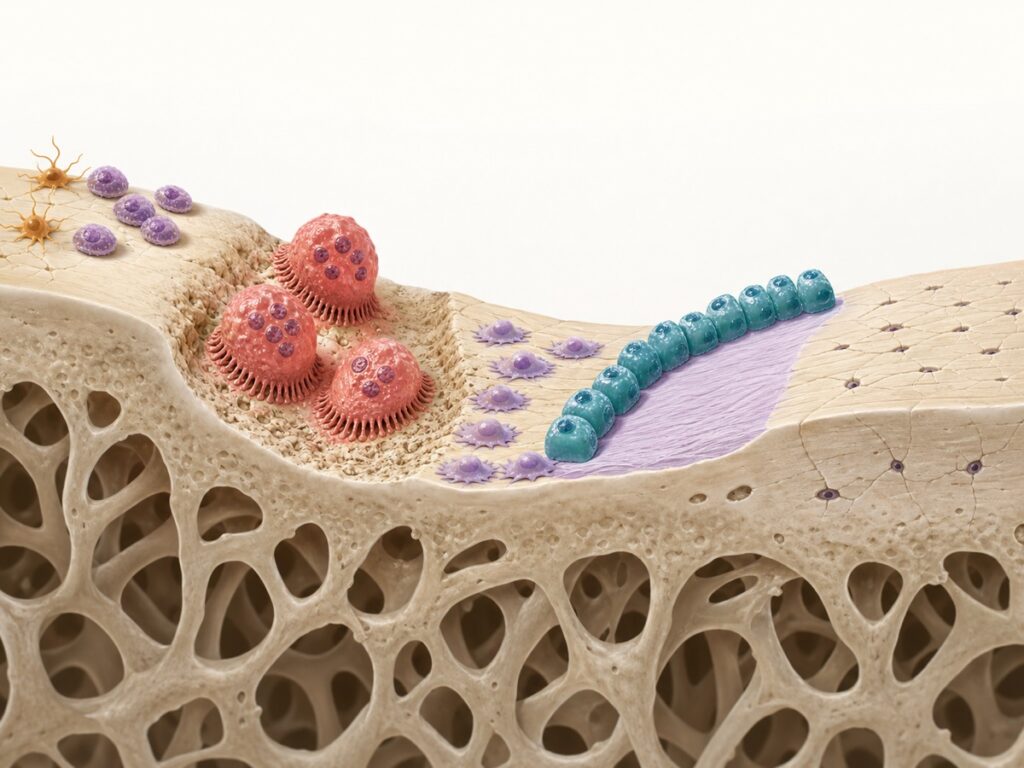
Bone is living tissue that is constantly being renewed.
With aging, illness, low hormones, inactivity, or certain medications, the remodeling balance can tilt so that removal outpaces rebuilding over time.
What changes over time
Bone is constantly remodeled. Older bone is removed and new bone is formed. As we age, remodeling can become less balanced and bone microarchitecture can deteriorate. Cortical bone may become more porous and trabecular connections may thin, so strength can decline before a person feels anything.
At the same time, muscle mass, balance, vision, medications, and reaction time can change. That combination is important: weaker bone raises fracture risk, and more falls give weaker bone more chances to break. Sarcopenia and frailty are part of this same prevention conversation, not separate problems.
What I see after fractures
In orthopedics, I often meet people after an injury. The broken bone gets immediate attention because it hurts and it shows up on x-ray. The quieter question is sometimes missed: why did this fracture happen from this fall?
That question is not about blame. It is about prevention. A fracture can be a warning sign that the next fall deserves a stronger plan.
Useful questions to bring up
- Was this fracture more than I should expect from the injury?
- Should I be screened for osteoporosis or other causes of weak bone?
- What can I do for strength, balance, and fall prevention?
- Are any of my medications increasing fall risk or affecting bone?
Evidence review
Biology
Bones weaken with age because remodeling balance, sex hormones, muscle forces, nutrition, inflammation, kidney function, medications, and comorbid illness change over time. Aging is not one mechanism; it is a stack of small losses that can eventually reduce reserve.35
Epidemiology and risk
Fracture risk rises with age because bone strength often declines while fall risk rises. A person may lose muscle, balance, vision, reaction speed, or confidence at the same time bone density is falling, which is why fracture prevention has to look beyond the scan.38
Evaluation
Evaluation should ask what is driving risk now: prior fracture, DXA pattern, fall history, frailty, medication exposure, nutrition, kidney function, endocrine disease, inflammatory disease, and whether pain or fear has reduced activity. Secondary causes and drug-induced bone loss become more common as medical complexity increases.63
Treatment strategy
The strategy is not to pretend aging can be avoided. It is to preserve reserve: progressive strength and balance work, enough protein and calcium, vitamin D correction when deficient, medication review, fall-risk reduction, and osteoporosis medication for people whose fracture risk is high enough.98
References
- Sfeir JG, Drake MT, Khosla S, Farr JN. Skeletal aging. Mayo Clin Proc. 2022;97(6):1194-1208. doi: 10.1016/j.mayocp.2022.03.011. PMID: 35662432.
- Pignolo RJ. Aging and bone metabolism. Compr Physiol. 2023;13:4355-4386. doi: 10.1002/cphy.c220012. PMID: 36715278.
- Morin SN, Leslie WD, Schousboe JT. Osteoporosis: a review. JAMA. 2025. doi:10.1001/jama.2025.6003.
- Wong RMY, Wong H, Zhang N, et al. The relationship between sarcopenia and fragility fracture: a systematic review. Osteoporos Int. 2019;30(3):541-553. doi:10.1007/s00198-018-04828-0.
- Ye C, Ebeling P, Kline G. Osteoporosis. Lancet. 2025. doi:10.1016/S0140-6736(25)01385-6. PMID:40946719.
- Gasser RW, Kocijan R, Zendeli A, Resch H. Drug-Induced Osteoporosis. J Clin Med. 2026. doi:10.3390/jcm15030993. PMID:41682673.
- Cheng J, Wu X, Zhao L, Jiang S, Zhao W, Zhang W. Estrogen deficiency as a common driver and integrative mechanism in osteoporosis-osteoarthritis comorbidity (Review). Mol Med Rep. 2026. doi:10.3892/mmr.2026.13910. PMID:42169635.
- Dent E, Daly RM, Hoogendijk EO, Scott D. Exercise to Prevent and Manage Frailty and Fragility Fractures. Curr Osteoporos Rep. 2023. doi:10.1007/s11914-023-00777-8. PMID:36976491.
- Rizzoli R, Chevalley T. Nutrition and Osteoporosis Prevention. Curr Osteoporos Rep. 2024. doi:10.1007/s11914-024-00892-0. PMID:39322861.
Educational Use Only
This website is educational. It is not a medical practice, telemedicine service, or a substitute for care from your own clinician.