Osteoporosis basics
What is osteoporosis?
Osteoporosis means bone strength has fallen enough that a fracture can happen more easily than it should. A DXA scan helps, but the whole story is bigger than one number.
Visual explainer
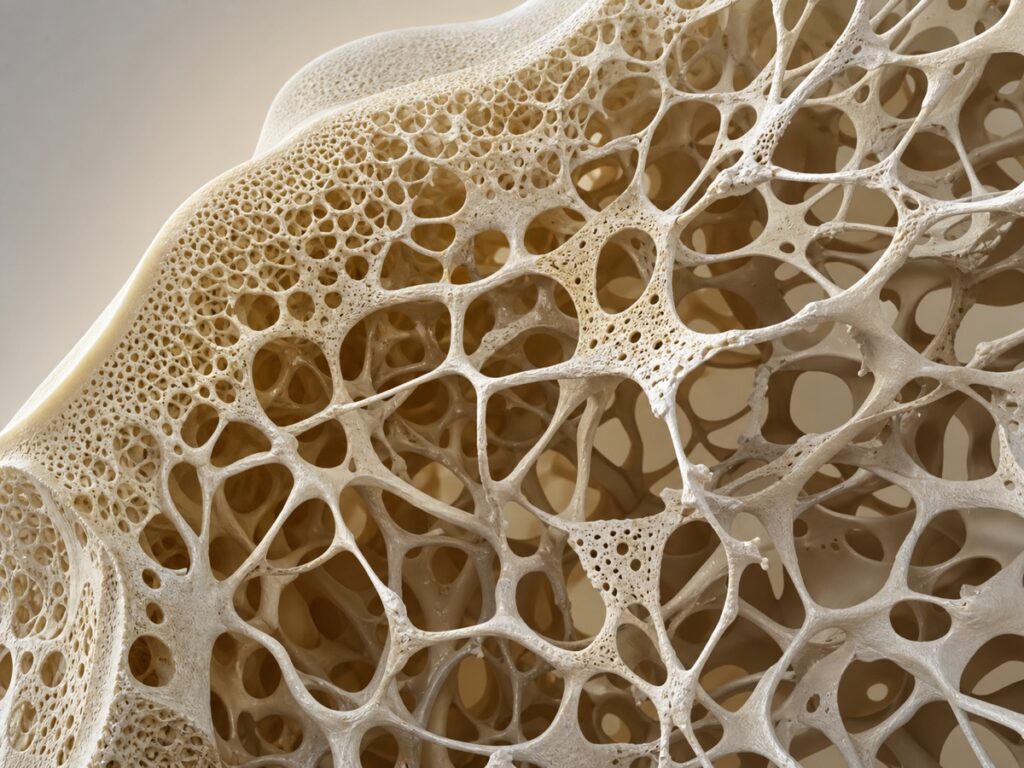
Osteoporosis is about architecture, not just density.
The thinning struts and wider open spaces in trabecular bone help explain why a bone can become more fragile even when the outside shape looks unchanged.
The short version
Osteoporosis is more than a low DXA number. It is a condition in which low bone mass and changes in bone structure reduce bone strength, so the skeleton has less reserve against ordinary falls or daily forces.
That is why a low-energy fracture matters. A wrist, hip, shoulder, or spine fracture after a simple fall can be the first sign that bone strength, fall risk, medications, and medical contributors deserve attention, not just the broken part.
Bone density and bone quality
Bone density is the amount of mineral measured in bone, often with a DXA scan. Bone quality includes architecture, turnover, mineralization, microdamage, and other structure-related features that help explain why strength is not captured by one number alone.
In real life, both matter. A T-score is useful, but it does not tell the whole story by itself. Age, prior fracture, medications, family history, falls, medical conditions, muscle, and strength all help determine what the number means for you.
References
- Consensus development conference: prophylaxis and treatment of osteoporosis. Br Med J (Clin Res Ed). 1987;295(6603):914-915. doi: 10.1136/bmj.295.6603.914. PMID: 3119099; PMCID: PMC1247945.
- Kanis JA. Assessment of fracture risk and its application to screening for postmenopausal osteoporosis: synopsis of a WHO report. Osteoporos Int. 1994;4(6):368-381. doi: 10.1007/BF01622200. PMID: 7696835.
- US Preventive Services Task Force; Nicholson WK, Silverstein M, Wong JB, Chelmow D, Coker TR, Davis EM, Jaen CR, Krousel-Wood M, Lee S, Li L, Mangione CM, Ogedegbe G, Rao G, Ruiz JM, Stevermer J, Tsevat J, Underwood SM, Wiehe S. Screening for Osteoporosis to Prevent Fractures: US Preventive Services Task Force Recommendation Statement. JAMA. 2025;333(6):498-508. doi: 10.1001/jama.2024.27154. PMID: 39808425.
- NIH Consensus Development Panel on Osteoporosis Prevention, Diagnosis, and Therapy. Osteoporosis prevention, diagnosis, and therapy. JAMA. 2001;285(6):785-795. doi: 10.1001/jama.285.6.785. PMID: 11176917.
- Morin SN, Leslie WD, Schousboe JT. Osteoporosis: a review. JAMA. 2025. doi:10.1001/jama.2025.6003.
- Compston JE, McClung MR, Leslie WD. Osteoporosis. Lancet. 2019;393(10169):364-376. doi:10.1016/S0140-6736(18)32112-3.
Educational Use Only
This website is educational. It is not a medical practice, telemedicine service, or a substitute for care from your own clinician.